
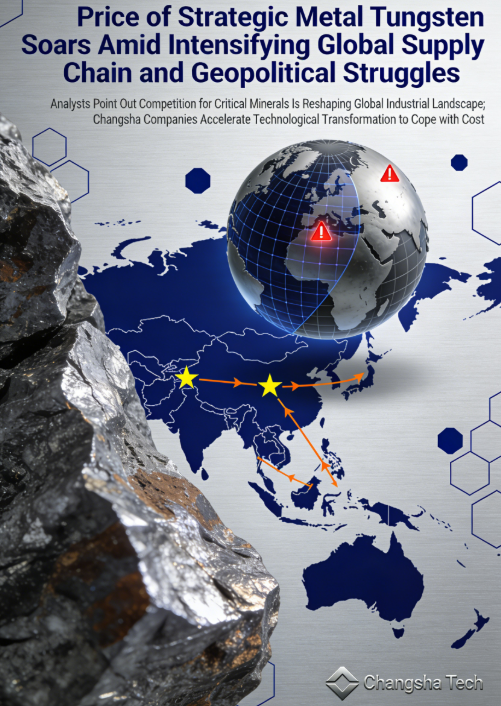
Subtitle: Analysts Point Out Competition for Critical Minerals Is Reshaping Global Industrial Landscape; Changsha Companies Accelerate Technological Transformation to Cope with Cost Pressures
Location: Changsha, China
Date: January 23, 2026
(Changsha) — Over the past year, international tungsten prices have continued to climb, reaching a decade-high. This once-overlooked gray metal has now become a focal point on the strategic reserve lists of many countries due to the global energy transition and geopolitical competition. Industry reports indicate that tungsten prices on the London Metal Exchange have risen by over 60% year-on-year, triggering a chain reaction in the manufacturing sector.
Dual Drivers: Supply Crunch and Geopolitics
Tungsten, a rare high-melting-point metal, is primarily mined in China, Russia, and Vietnam. Since 2025, China, the world’s largest tungsten producer, has implemented stricter environmental regulations for mining. Meanwhile, the European Union’s pre-approval requirements for critical raw material exports have further tightened the market.
“Tungsten’s supply chain is more concentrated than that of rare earths,” said Professor Li Zhen from the School of Materials Science and Engineering at Changsha University of Science and Technology. “Any policy changes or trade frictions in major producing regions directly impact global prices.” Recent disruptions in Red Sea shipping and transportation lines for tungsten mines in Central Africa have further driven up logistics costs.
Additionally, the U.S. Department of Defense prioritized tungsten procurement under the Defense Production Act in 2025, expanding its strategic reserves. Analysts note that competition among major powers in advanced manufacturing and defense is elevating tungsten to the status of an “invisible strategic weapon.”
Tungsten: The “Industrial Teeth” From Light Bulbs to Space
Tungsten’s wide range of applications has intensified demand pressures. Its primary uses include:
- Hard Alloy Manufacturing: Used in cutting tools and mining drill bits, accounting for 60% of global tungsten consumption;
- Defense and Aerospace: Essential for armor-piercing projectiles, rocket engine nozzles, and satellite components;
- New Energy Transition: Required for wind turbine bearings and electric vehicle battery electrode coatings;
- High-Tech Consumer Electronics: Used in mobile phone vibration motors and semiconductor chip heat sinks;
- Traditional Industrial Applications: Found in incandescent lamp filaments and nuclear reactor shielding materials.
“Tungsten’s irreplaceability lies in its ultra-high melting point and hardness,” said Wang Mingyuan, Technical Director of Changsha Hard Alloy Group. “Especially in precision manufacturing, nano-level tungsten alloy tools directly determine the quality of high-end products.”
Changsha Companies Actively Respond to Supply Chain Challenges
As a significant hard alloy production base in China, Changsha companies are mitigating cost pressures through technological upgrades. Hunan Tungsten Co., Ltd. announced plans to increase the proportion of recycled tungsten from 35% to 50% and develop low-tungsten, high-performance alloys.
At the same time, local companies are accelerating overseas resource investments. In November 2025, the Changsha Mining Alliance reached a joint development agreement for tungsten mines with Kazakhstan, aiming to diversify supply sources.
“Short-term price fluctuations may persist, but in the long run, technological substitution and the circular economy will be key,” said Chen Lin, Secretary-General of the Hunan Nonferrous Metals Industry Association. “China’s technological advantages in deep processing of tungsten are expected to translate into supply chain resilience.”
Future Trends: Green Transition and Global Competition
The International Energy Agency predicts that demand for tungsten in clean energy technologies will triple by 2040. Although countries like Australia and Canada have resumed tungsten exploration, the lengthy mining cycles make it difficult to alter the supply landscape in the short term.
Wall Street analysts warn that soaring tungsten prices could drive up manufacturing costs globally, particularly in the automotive and machinery sectors. Some European companies have begun researching substitutes such as molybdenum and titanium, though performance gaps are unlikely to be bridged soon.
Disclaimer: Data in this article is sourced from the International Tungsten Association, Reuters, and industry white papers.