
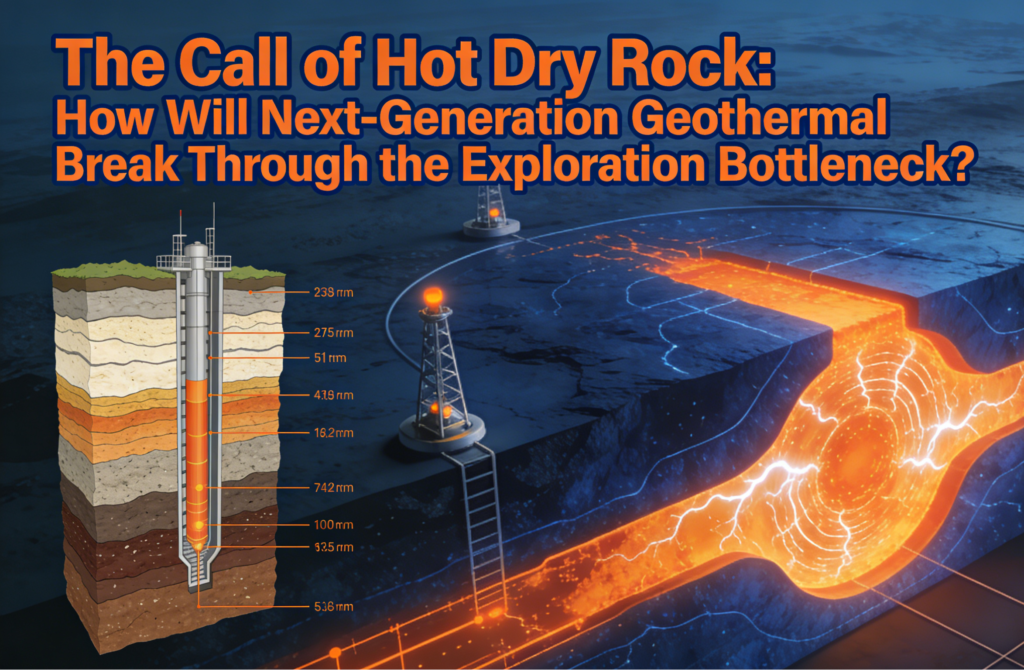
On January 6, 2026, the U.S. Department of Energy officially approved special budgets for three Enhanced Geothermal Systems (EGS) pilot projects, a decision set to transform “hot dry rock” buried kilometers underground into a clean energy source for large-scale utilization.
01 Technical Challenges
Traditional geothermal development relies entirely on specific geological conditions, with “hydrothermal” geothermal resources suitable for development globally being extremely limited. In contrast, hot dry rock resources are found worldwide, lying deep within high-temperature rock formations several kilometers underground.
The problem is that these rocks contain almost no natural fluids. How to efficiently and economically extract thermal energy from them has become the core technical challenge facing scientists.
Enhanced Geothermal Systems (EGS) were born to solve this very problem. The system creates an underground heat exchanger through engineered reservoir stimulation in high-temperature rock layers, converting deep geothermal heat into usable electricity or thermal energy.
02 The Geothermal Revolution
The inclusion of EGS pilot projects as a key focus in the 2026 U.S. Department of Energy budget marks the transition of hot dry rock development from conceptual validation to the eve of commercialization. From MIT to Stanford University, multiple research teams are engaged in collaborative efforts.
Unlike traditional geothermal, EGS does not depend on natural geothermal reservoirs but instead creates an artificial underground heat exchange system.
The system injects water under high pressure into hot, low-permeability rock formations, creating a network of micro-fractures that form an efficient heat exchange area. Cold water is heated as it passes through this fracture network and is then returned to the surface via production wells to drive turbines for power generation.
A Comparative Look at U.S. and Chinese EGS Research Focus
The United States and China exhibit distinct characteristics and priorities in their EGS research and development, with core differences evident in their technological pathways, demonstration projects, and application goals.
The U.S. approach centers on the “FORGE” (Frontier Observatory for Research in Geothermal Energy) initiative as its flagship program, employing an open collaboration and standardized testing model. It invites global teams to test innovative technologies at a unified site.
Located in Milford, Utah, the project focuses on tackling three major challenges: efficient drilling, precise reservoir creation, and long-term sustainability. Successful 2025 trials achieved closed-loop water circulation and stable thermal energy extraction, laying the groundwork for expanded piloting in 2026.
China’s exploration is underpinned by national-level deep-earth science and technology projects, concentrating on deep high-temperature rock drilling and reservoir stimulation techniques. During the “13th Five-Year Plan” period, it drilled to a hot dry rock body at 236°C, 3700 meters deep in the Gonghe Basin, Qinghai, and conducted EGS trials in multiple locations including Fujian and Guangdong.
The “China Hot Dry Rock Resources Research Report” released by the China Geological Survey in 2024 indicates that the estimated hot dry rock resources within 3-10 kilometers under the Chinese mainland are equivalent to 856 trillion tons of standard coal. Exploiting just 2% could meet the country’s 2025 energy demand for 4,000 years.
03 Breaking Through Bottlenecks
The path to EGS commercialization is still obstructed by multiple technical hurdles. Accurately predicting and controlling fracture network propagation is the primary challenge. Under the high-temperature, high-pressure conditions kilometers underground, understanding how fractures extend, whether they might induce micro-seismicity, and how to maintain stable heat exchange efficiency all require more advanced monitoring and control technologies.
Breakthroughs in deep drilling technology, exemplified by China’s drilling vessel “Meng Xiang”, directly propel EGS development. From ultra-high-temperature drilling fluids and downhole instruments capable of withstanding extreme heat—developed with participation from several research institutes in Changsha, Hunan—to completion technologies tailored for hot dry rock development, preparations are underway to unlock geothermal resources above 300°C at greater depths.
The integration of micro-seismic monitoring, fiber optic sensing, and AI algorithms now allows engineers to “see” the shape and expansion of underground fracture networks in real-time, significantly improving the precision and safety of reservoir creation.
04 Commercialization Hurdles
Economic viability is the key factor determining whether EGS can achieve large-scale application. According to U.S. Department of Energy estimates, by 2030 the levelized cost of electricity from EGS could potentially fall to $0.05-$0.08 per kilowatt-hour, making it competitive with solar PV and onshore wind power.
EGS systems also possess unique advantages—they are unaffected by weather and can provide stable, 24/7 power supply, enabling them to serve as baseload power supporting grid stability, a capability intermittent renewables cannot match.
Beyond power generation, EGS shows significant potential in the field of industrial heating. Industries such as cement, chemicals, and metallurgy require large amounts of medium-to-high temperature heat, traditionally supplied by burning fossil fuels.
The stable 150-300°C thermal energy provided by EGS offers a viable decarbonization path for these energy-intensive sectors. The combination of abundant hot dry rock resources and a strong industrial base in areas surrounding Changsha could make it an ideal region for the early application of this technology.
05 Future Outlook
The future development of Enhanced Geothermal Systems will likely unfold along three dimensions: deeper drilling, higher temperatures, and broader applications. As technology advances, future EGS projects may tap into deeper, hotter hot dry rock resources, pushing geothermal utilization to new heights.
The synergy between geothermal, solar, and wind energy is also on the research agenda. Geothermal provides stable baseload power, while solar and wind offer variable supplementation; such hybrid systems could create more reliable and economical clean energy solutions.
Policy support will be a crucial driver for EGS commercialization. Beyond the specific allocations in the U.S. 2026 budget, programs like the EU’s “Horizon Europe” and China’s deep-earth exploration and energy storage initiatives have all listed EGS as a priority.
Multiple research institutes in Changsha are already involved in developing technologies related to hot dry rock, from high-temperature-resistant materials to geothermal power generation equipment, gradually forming a complete technological chain.